
7.3.5What is the slope field pattern?
Plotting Slope Fields Efficiently
Theresa enjoys tedious tasks, so slope fields are among her favorite graphs to sketch. However, her teammates desire a more efficient method to plot slope fields. Sketch each of the following slope fields as efficiently as possible.
Plot each slope field and trace a few particular solutions. Describe the shape of the particular solution—is it familiar?
Describe any patterns you used. For example, where is the slope horizontal? Where is it undefined (or vertical)?
Use implicit integration to solve the differential equation. Compare the solution to the slope field. Explain any inconsistencies. Hint: Consider looking at the standard form of the solution.
Discuss with your team how to plot the following slope fields. Will the tangent lines be parallel? If so, in which direction? Then sketch each slope field on your own paper.
Write an equation for the general solution to each differential equation using implicit integration. Discuss any similarities and differences.
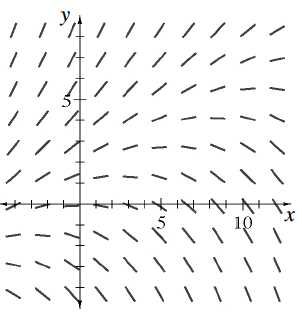
The slope field at right represents the differential equation
On your paper, plot a particular solution containing the point
. Plot another solution containing the point . For this slope field, the different solutions do not look the same. Why not?

Your teacher will give you a slope field resource page and two sets of cards. Your task is to match each graph with its differential equation and its general solution. Be sure to discuss your choices with your team and explain your reasoning. Do not use a calculator!

Solving Differential Equations with Slope Fields
A differential equation is an equation that relates a function,
Solutions to differential equations are functions or families of functions (or relations). The equation of the solution function and its derivatives can be substituted into the differential equation to verify that the solution function is correct. This equation can be in the form of a particular solution (when a coordinate point on the graph of the function is known) or a general solution (which includes a generic constant).

A slope field is a sketch of a collection of small tangent lines whose slopes are equal to
For example, the slope field of the differential equation
It is important to remember that a slope field cannot cross a vertical asymptote, locate a point of discontinuity, or have a sudden jump.

For each of the derivative functions below, write the equations of two different possible functions for
Use the identity
In order to calculate the average value of a function, sometimes it makes sense to integrate while other times the slope of a secant line is determined. When do you need to use each strategy? Homework Help ✎
Solve for
Then use the slope field for
.png)
Let
Describe the change in temperature of the tea in relation to the room temperature.
What is the temperature of the tea at any time
? What is the temperature of the tea after
minutes?
Use Newton’s Method to calculate the
Multiple Choice: Two particles start at the origin and move along the